Custom Perfume Manufacturing: A Realistic Timeline and Where It Slips
A custom perfume project has two clocks running at once, and they are not the same clock. One measures the scent: development, sampling, revision, approval. The other measures everything physical: bottle, pump, cap, carton, decoration, filling and freight. The scent clock is the one founders watch, and the packaging clock is the one that decides whether the launch date holds. Planning both from the start is the difference between a schedule and a hope.
Key takeaways
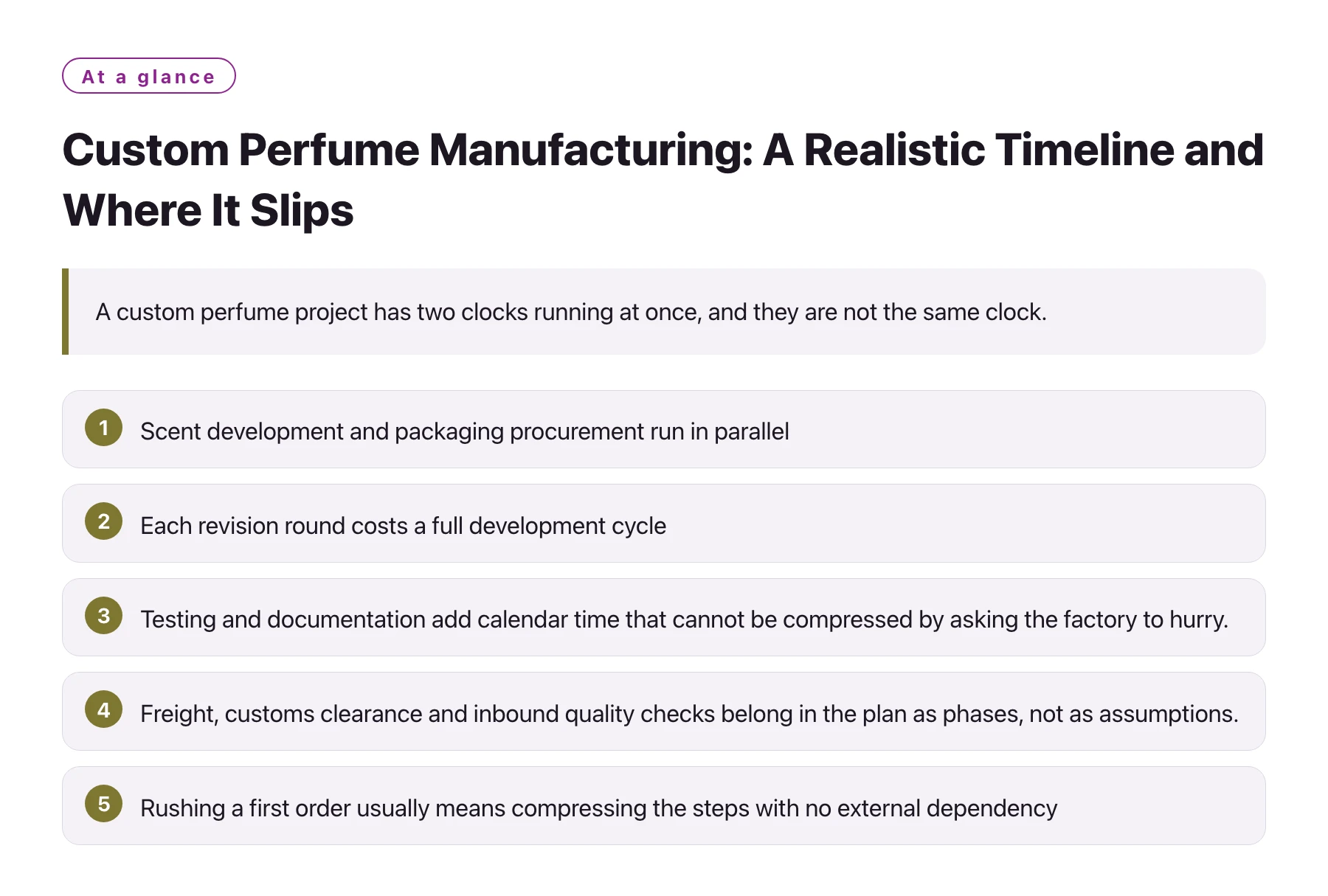
- Scent development and packaging procurement run in parallel, and starting the packaging chain late makes it the critical path regardless of how quickly the formula is approved.
- Each revision round costs a full development cycle, so feedback quality affects the timeline more than the number of rounds does.
- Testing and documentation add calendar time that cannot be compressed by asking the factory to hurry.
- Freight, customs clearance and inbound quality checks belong in the plan as phases, not as assumptions.
- Rushing a first order usually means compressing the steps with no external dependency, which is rarely the ones causing the delay.
Founders typically build a timeline by adding up the phases they can see: brief, sample, order, ship. The result is optimistic, because the phases they cannot see are the ones that take the longest. A pump component with a long lead time, a silk screen that needs re-cutting, a testing slot in a laboratory calendar — none of these appear in the mental model and all of them appear in the schedule.
It helps to treat the project as two tracks that must converge on one date. The scent track is managed by the perfumer and the brand. The packaging track is managed by whoever is sourcing components. Both need a date attached at the beginning, and both need to be visible to the person holding the launch calendar.
Why timelines slip in the same places
The pattern repeats across first projects. A brand approves a sample after a revision round, then begins looking at bottles, and only then discovers that the chosen pump is quoted at a lead time longer than the remaining schedule. The formula is ready, the packaging is not, and the launch date was set before either was known.
The other recurring slippage is feedback latency. A sample travels from factory to brand, sits on a desk for a week, is evaluated informally, and returns with comments that describe dissatisfaction rather than direction. Each of those loops consumes a full cycle, and three of them will absorb more time than any production problem.
The phases, and what has to be ready for each to start
| Phase | What it needs to start | Planning assumption | Most common delay |
|---|---|---|---|
| Brief and feasibility | Written specification with the four constraints | A few days to a couple of weeks | A brief that describes a mood rather than a product |
| Formula development | Approved brief and named references | Weeks rather than days | References that contradict each other |
| Sampling and revision | Laboratory sample and shipping time | One to three rounds is typical | Comments that do not describe a direction |
| Packaging sourcing | Pack format, artwork direction and quantity | Often the longest external lead time | Components sourced after the formula is approved |
| Decoration and print | Finalised artwork and a proof approval | Depends on the process chosen | Artwork changed after the proof stage |
| Bulk production | Approved sample, components on site, cleared documents | A production slot, not a fixed figure | Late component arrival, or a change after approval |
| Release, freight and clearance | Inspection passed and documents complete | Add transit and clearance time on top | Documentation gaps found at the border |
The table is not a quotation; it is a dependency map. Ask a supplier to fill in their own assumptions for each row, and the conversation becomes specific quickly.
What can and cannot be compressed
Founders looking at a long schedule usually ask what can be accelerated. Some of it can, and knowing which parts is what prevents pointless pressure on the wrong stage.
Compressible, with money or with decisions
Packaging can be pulled earlier by choosing components from existing stock rather than commissioning new tooling. Sampling can be shortened by writing a direction-rich brief and by evaluating samples on the day they arrive. Production can sometimes be moved up by holding a slot in advance, which is a planning decision rather than a manufacturing one.
Not compressible by asking politely
Testing and documentation take the time they take, because they depend on external laboratories, assessors and market procedures rather than on the manufacturer's willingness. This is calendar time that should be planned for rather than negotiated down; a supplier that promises to shorten it is more likely to be compressing the quality of the work than the duration of the step [1].
The hidden dependency: component compatibility
A component can pass every internal check and still fail in combination — a cap that does not seal against a particular concentrate, a label that will not adhere to a coated surface, a pump whose output volume changes the perceived strength. Testing the assembled pack early is part of the timeline, not an optional extra, because discovering an incompatibility after the components are ordered means a second order.
Build the timeline backwards from the launch date and mark two dates in red: the day the artwork must be final, and the day the components must be ordered. Both land well before the scent is approved, and both are the reason projects with perfect samples still miss their window.
Planning the project around the date you actually need
The most useful planning tool is not a schedule but a decision about which date matters. If the launch is tied to a season or a retail window, the packaging clock has to start immediately, which in turn means the pack format must be chosen before the formula is finished.
If the date is flexible, the project can be sequenced for cost instead: finish the formula, then source components without expediting anything. That route usually produces a better product per unit of spend, and it requires the brand to resist announcing a date until the components are confirmed.
Where a first order is genuinely urgent, the honest options narrow to using components that already exist and accepting a standard pack. A manufacturer that works with a broad range of formats is easier to plan around in that situation, because the fast route does not require new tooling. Comparing from idea to a perfume brand with your own sequence is a quick check on whether the plan has phases you have not accounted for.
Whichever route is chosen, one phase deserves protection: the gap between approving the sample and starting bulk production. Products approved quickly and produced immediately sometimes differ from the sample in ways nobody catches until the bottles arrive. A short, deliberate interval for the approved sample to settle, and for the paperwork to be confirmed, is the cheapest insurance in the entire schedule, and it is also the phase most often sacrificed when a custom perfume manufacturer is asked to compress a plan at the last minute.
Finally, write the assumptions down. Any timeline built on lead times from a supplier's email is a guess until those lead times are confirmed in writing, with the component names attached. A plan with named dependencies can be managed; a plan with a single total number can only be missed. The material on why a sample and the bulk order can differ explains why the interval between approval and production is worth protecting rather than absorbing into the schedule.
A short pre-mortem that saves weeks
Before the first order, ask the team to name the three things most likely to go wrong and the date each would become visible. Most answers will involve a component, a document or a decision rather than the scent itself, and each answer gives the project a checkpoint to watch.
Sources
- SGS: Cosmetics, Personal Care & Household Testing —— Testing, inspection and certification services for cosmetics and personal care, including microbiological, stability and safety testing aligned with cosmetics GMP.
Frequently asked questions
How long does custom perfume development take?
Plan for a sequence rather than a single figure: brief, formula development, one to three sample rounds, approval, then packaging and production. Development usually runs in weeks, and packaging often runs longer than the scent work does.
Can I speed up sampling?
Yes, by improving feedback rather than by asking for speed. Comments that describe a direction, plus two or three reference products, reduce the number of rounds. Fast evaluation on arrival helps as well, because a sample waiting on a desk costs the same calendar time as a sample being revised.
What is the longest lead time in a perfume project?
Packaging components, in most cases. Bottles, pumps, caps and cartons come from separate suppliers with separate schedules, and any custom mould or decoration adds its own queue. Starting that track early is the single most effective schedule decision available.
Should I order packaging before the formula is approved?
Often yes, provided the pack format is genuinely fixed and the concentrate is not expected to change the component choice. If there is a chance the formula will change viscosity or compatibility, confirm that with the manufacturer before committing to a component order.
How much buffer should a first launch plan include?
Enough to absorb one full revision round and one component delay, because those are the two events that occur most often. A plan with no buffer is not a plan; it is a best case with a date attached.